School vision screenings are helpful—but they are not the same as a comprehensive eye exam. This guide explains the difference, when a screening is enough as a first step, and when Stuart parents should book a full pediatric eye exam.
What a Vision Screening Checks
A vision screening—at school, a pediatrician’s office, or a community event—is a quick check. It usually looks at how clearly a child sees letters or shapes across a room. Screenings are designed to flag children who may need a closer look. They are not meant to diagnose every vision problem or evaluate eye health in detail.
What a Comprehensive Eye Exam Includes
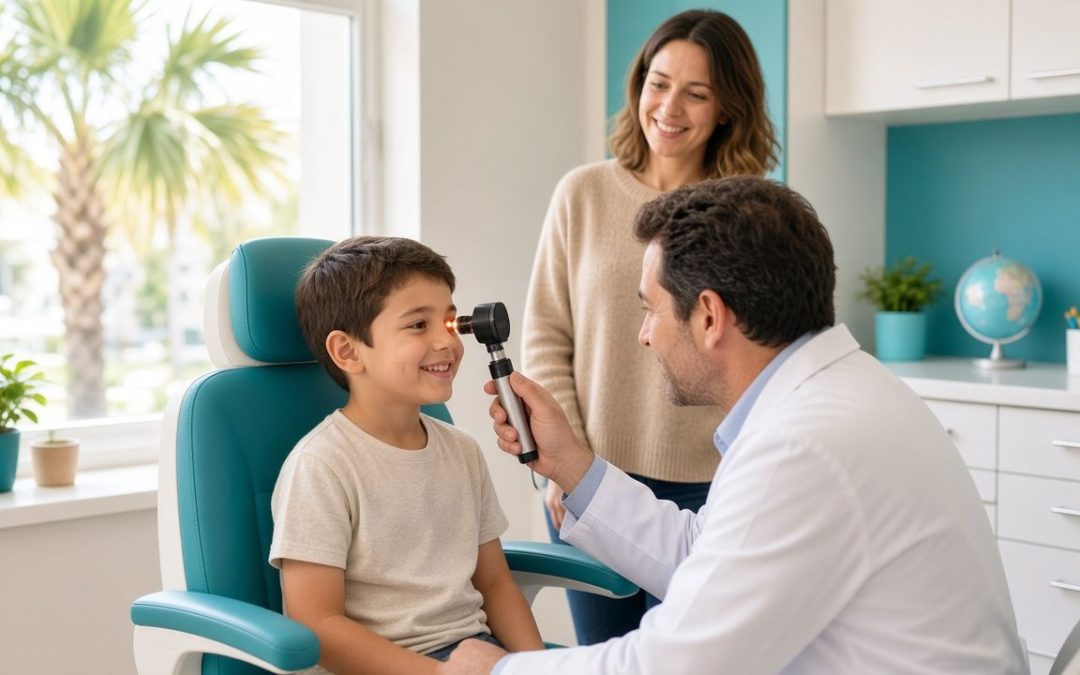
A comprehensive eye exam with an optometrist goes further. Depending on your child’s age, it may include:
- Precise prescription testing for nearsightedness, farsightedness, and astigmatism
- Eye teaming and focusing tests
- Eye health evaluation of the front and back of the eyes
- Checks for lazy eye (amblyopia) and eye turns
Sometimes eye drops are used to relax focusing and get an accurate prescription. Parents are welcome in the room, and results are explained before you leave.
Why Screenings Can Miss Problems
A child can pass a distance screening and still have farsightedness, astigmatism, focusing issues, eye teaming problems, or early eye-health concerns. Kids also rarely complain about blurry vision because they don’t know what “clear” is supposed to look like. That’s why eye care experts recommend a complete eye exam every year for most school-age children—not only when a screening raises a flag.
Free Kids Vision Screening (Ages 5–17)
Stuart Family Eye Care offers a Free Kids Vision Screening for ages 5–17. It’s a quick, no-cost check that can flag possible vision problems. A screening isn’t a full eye exam. If we find something that needs a closer look, we’ll recommend a comprehensive exam and explain why.
Nearsightedness and Myopia Control
If an exam shows your child is becoming more nearsighted, ask about myopia control. Options we offer include Ortho-K overnight lenses, MiSight® 1 day contact lenses, Stellest® eyeglass lenses, and low-dose atropine eye drops (used off-label for myopia control). Results vary from child to child. Parents of children ages 5–12 can start with a free virtual myopia control consultation by video or phone. Learn more on our Myopia Control page.
Is a school vision screening the same as an eye exam?
No. A screening is a quick check for possible problems. A comprehensive eye exam measures the exact prescription and evaluates eye health and how the eyes work together.
My child passed the school screening. Do they still need an exam?
Yes. Many vision and eye-health issues can be missed by a screening. Eye care experts recommend yearly comprehensive eye exams for most school-age children.
What ages is the Free Kids Vision Screening for?
Ages 5–17. It’s a quick, no-cost check that can flag possible vision problems. It is not a full eye exam.
When should I book a full pediatric eye exam?
Book an exam if a screening flags a concern, if you notice squinting, headaches, or trouble with reading or the board, or as part of your child’s yearly eye care routine.
Book a Kids’ Eye Exam in Stuart
Request an appointment online, or Call or Text 772-208-3924 (text us). We’re here to help your child see clearly at school, at play, and everywhere in between.
Stuart Family Eye Care · 3332 SE Salerno Rd, Stuart, FL 34997 · Hours: Mon–Fri 9:00am–5:00pm · Call or Text 772-208-3924 (text us) · Text us