Stuart’s humidity does not need much help to fog a pair of glasses. A short walk from a cooled shop on Salerno Road into the midday air can do it. So can a pot of boiling water, a tight crawl space, or getting in and out of a patrol car on a summer shift. If that sounds like your workday, this guide to Optifog lenses is for you.
At Stuart Family Eye Care, at 3332 SE Salerno Rd, we meet plumbers, chefs, air-conditioning technicians, and police officers tired of wiping their lenses at the worst possible moment. Optifog is one option we can discuss. It is an anti-fog lens from Essilor, not a miracle claim, and it should not be confused with Crizal.
Plumbers and HVAC Work in Stuart’s Heat
A plumber who has been under a house or around a water heater can step into cooler air and watch a clear lens go cloudy in seconds. An HVAC technician climbing in and out of attics runs into the same physics.
What is happening is simple condensation. Warm, humid air hits a cooler lens, water vapor becomes tiny droplets, and the world turns fuzzy until the lens dries or is wiped. In Stuart, that cycle can repeat many times in a single job. When you are looking at a fitting, a live wire, or a tight mechanical space, waiting for a lens to clear is no small inconvenience.
Essilor presents Optifog as a helpful choice for people who face big temperature changes at work, which fits a lot of the trade work we see here. Essilor also offers Optifog on prescription safety glasses, which is worth asking about if your job requires safety eyewear.
Restaurant Kitchens and Patrol Cars
The same pattern shows up in very different workplaces.
- Chefs, line cooks, and dishwashers spend hours around steam, open pots, ovens, and wet dish stations. Walking from a hot line into a cooler dining room is often enough to fog a lens.
- Police officers and other first responders get in and out of patrol cars all day. A cooled cabin, then humid outdoor air, can cloud glasses just as a situation needs their full attention.
- Masks or face coverings, when they are part of a shift, can send warm breath up toward the lenses and add more condensation.
These are the kinds of details worth mentioning at your exam. The more specific you are about when the fog appears, the easier it is to talk about whether Optifog or another option is the practical path.
The Hydrophilic Layers Behind Optifog
Essilor describes Optifog lenses as having unique hydrophilic top layers with inherent fog-repelling properties. In plain language, the surface is designed to attract water and spread it, rather than letting it bead into a cloudy film.
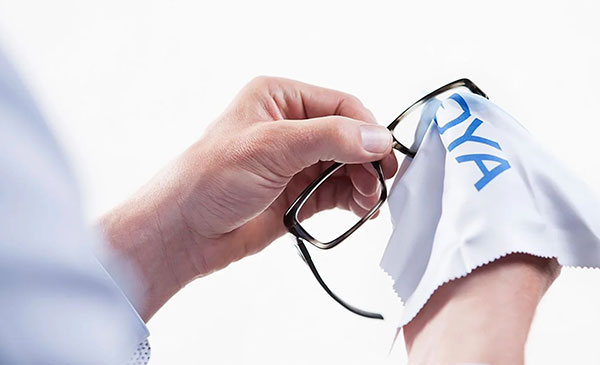
Those top layers are not simply sitting there, ready on their own, for the life of the glasses. They are activated with the Optifog Activator Cloth. Essilor says the cloth both activates the layers and cleans the lens, and that you should use it as part of regular lens cleaning. After activation, moisture that would otherwise look like fog is described as spreading into a thin, even, essentially invisible film of water.
The cloth is part of the system, not an optional accessory. Use it as directed, and follow the cleaning guidance that comes with the glasses. If anything about cleaning or cloth replacement is unclear, ask us rather than substituting a regular cloth or a paper towel.
Keeping Expectations in Perspective
Two limits matter as much as the benefits. First, Optifog is not a permanent treatment that you can ignore after the glasses are made; activation with the special cloth is part of how the lens is meant to work. Second, it is not a promise that lenses will never fog. Weather, work conditions, and care all play a role, and we will not sell the idea of a lens that fogs under no circumstances.
It is also not a spray you apply to an old pair of glasses. Anti-fog drops or wipes on your current lenses are a different category of product. Optifog is built into the lens and paired with its own cloth.
Crizal’s Role in Everyday Lens Comfort
People often ask whether Crizal is the anti-fog option. It is not. Crizal is Essilor’s family of anti-reflective coatings, and it belongs in a different conversation.
Current Essilor descriptions of Crizal focus on protection against glare, scratches, and smudges, along with resistance to dust and water and lenses that are easier to clean. Those benefits can help on a bright Stuart afternoon or a night drive along the coast. They do not make Crizal an anti-fog product.
If reflections, fingerprints, or surface wear bother you more than condensation, start with Crizal. If condensation is the main issue, Optifog is the product aimed at fog. Some patients want to talk about both. Availability, and whether options can be combined on your lenses, should be reviewed with our office rather than assumed in advance.
If you move all day between dim interiors and strong Florida sun, ask about Transitions light-adaptive lenses. They are built to change with the light, and that feature can be considered apart from anti-fog performance.
Ask About Options at Your Yearly Eye Exam
A comprehensive eye exam each year is the right place to start. Even if you think your prescription has not changed, a yearly visit lets us confirm your vision, check the health of your eyes, and talk about the conditions you actually work in.
Bring your current glasses and, if you have them, any safety-eyewear requirements from your job. We can look at everyday frames, discuss prescription safety options, and go over whether Optifog is available and appropriate. If it is, we will also show you how the Activator Cloth fits into daily care.
Stuart Family Eye Care is at 3332 SE Salerno Rd, Stuart, FL 34997. Call us at (772) 208-3924, or request an appointment online.